Posted by Erin Roddy
on September 11, 2026



If you've stood in the feed aisle staring at bags labeled "gut health," "digestive support" or "hindgut balance," you're not alone.
Prebiotics and probiotics have been staples in equine supplements for almost 20 years, and postbiotics are the newer ingredient everyone is talking about. But what exactly are these -biotics? Is there any science to support the incorporation of -biotics in the daily management of horses? Can supplementation be harmful to our horses?
A healthy gut microbiome affects nearly everything: nutrient absorption, immune function, systemic well-being, sustained athletic performance, and disease prevention. Consequently, optimizing and supporting equine gastrointestinal health may help manage a variety of conditions; however, understanding the role of pre-, pro- and postbiotics in various disease states requires a deep dive into the available research to determine where our efforts — and our money — is best placed. Here is what the research says.
What are prebiotics for horses?
Prebiotics are compounds which are not directly digested by the horse yet provide health benefits when processed by the microbiota. Common examples of naturally occurring prebiotics in our horses' diets include:
- Inulin
- Fructooligosaccharides (FOS)
- Hemicellulose
- Beta-glucans
- Pectin
When gut bacteria break these down, they produce short-chain and branched-chain fatty acids, B vitamins, bile acid modifiers, indoles, and phenolic compounds. These metabolites play vital roles in mucosal barrier function, integrity, and immune responses, while also supplying energy and improving nutrient utilization.
The catch
More isn't always better. Overdoing supplementation beyond what is available naturally in our feedstuffs, for example, may lead to gastric ulceration because the byproducts of fermentation (like butyric acid) can disrupt the integrity of the gastric lining.
Are probiotics safe and effective for horses?
Probiotics are live microorganisms (bacteria, fungi, yeast, protozoa) that benefit the microbiome. But the bar for calling something a "true probiotic" is higher than most people realize. According to the International Scientific Association of Prebiotics and Probiotics (ISAPP), a probiotic must meet the following criteria:
- Contain specific living microorganism(s)
- Remain viable following administration
- Confer health benefits to the horse when administered in adequate amounts
- Maintain adequate colony-forming units (CFUs) through the end of their shelf life
By that definition, no equine product currently sold in the U.S. qualifies as a true probiotic.
- Most equine probiotic strains make up only a small percentage of the equine gastrointestinal microbiome, and dosing is often extrapolated from human research rather than equine-specific studies.
- Independent studies found that ~90% of the evaluated products did not contain the organisms listed on the label and only 2% contain the stated quantities.
- Many of the organisms fail to survive in environments which mimic the stomach, thus not reaching the hindgut.
- The U.S. supplement industry lacks clear regulation to verify probiotic use and dosage.
Are probiotics useful for adult horses?
In adult horses, clinical studies indicate that while probiotics are generally safe, their efficacy depends heavily on the specific product, microbial strain and clinical condition investigated. Research using Bacillus spp suggests benefits beyond the gastrointestinal tract through a reduction in exercise-related inflammation. However, a variety of clinical studies concluded that probiotics fail to (1) prevent antibiotic-induced dysbiosis, (2) decrease Salmonella shedding, or (3) improve outcomes in horses with acute enterocolitis. Despite evidence that some products might alter the microbiome in a test tube, research consistently indicates a lack of influence on outcomes for clinical cases.
Are probiotics safe in foals?
In foals, the findings are more concerning. Probiotic administration to healthy foals has consistently been linked to an increased incidence of diarrhea requiring veterinary intervention compared to foals given no probiotic. Furthermore, studies have failed to show significant effects on fecal microbiota composition or a reduction in the shedding of pathogenic bacteria in foals given probiotics as a preventative. Negative outcomes appear consistently across various strains and manufacturers, underscoring the need to rigorously assess the safety and efficacy of any product containing probiotics before it is used in foals.
What are postbiotics for horses, and why are they getting so much attention?
Think of it this way:
- Prebiotics — fuel for the gut bacteria
- Probiotics — the living organisms that use that fuel
- Postbiotics — the beneficial byproducts those organisms create
Postbiotics, which include inanimate microorganisms, cell wall fragments, enzymes, and other components, demonstrate improved functionality, shelf-life, and pass through following administration to horses compared to probiotics.
However, like probiotics, there is no US regulatory body overseeing the production of postbiotics and different manufacturing processes can yield significantly different metabolites. Further, the effects of postbiotics are dose dependent, so results from one product or ingredient don't necessarily apply to a competitor's version, even at the same dose.
Two well-studied categories
Digestive enzymes
Enzymes like cellulase and amylase, produced through fermentation of organisms such as Aspergillus niger and Bacillus licheniformis. These improve nutrient utilization and help prevent hindgut acidosis in horses on high-starch diets.
Saccharomyces cerevisiae fermentation products (SCFP)
The most extensively researched postbiotic in horses. SCFP has been shown to:
- Improve microbiome stability during transport stress
- Speed recovery after exercise
- Improve feed efficiency
- Strengthen immune response to vaccination
- Reduce joint inflammation in experimentally induced synovitis (joint inflammation)
The existing research suggests a significant effect of postbiotics, specifically Saccharomyces cerevisiae fermentation products, on the health, functionality and well-being of horses; however, future research is needed to confirm translation to clinical disease cases and performance outcomes.
Probiotics vs postbiotics: which should you choose?
It depends on the situation:
- Acute diarrhea in adult horses: May benefit from the administration of probiotics, particularly fecal transplantation from healthy horses; however, the evidence suggests that commercial probiotic administration does not improve outcomes.
- Routine, preventative probiotic use in healthy adult horses: Not well supported by current research and is contraindicated in neonatal foals.
- Foals: Routine probiotic use is not recommended as a preventive measure.
- Daily gut support: This is where postbiotics — particularly SCFP — currently have the strongest research behind them, showing improvement in microbiome stability, systemic inflammatory responses and mitigation of environmental and management stressors.
How to choose a quality probiotic or postbiotic supplement
Because strain, dose, manufacturing process, and delivery method all significantly affect whether a product actually works, look for:
- Transparent labeling — clear and direct ingredient list, limited fillers.
- Equine research — published research outlining the benefit of each ingredient in horses, not mice, sheep, or pigs.
- Third-party quality verification, such as NASC (National Animal Supplement Council) certification — since the U.S. supplement industry isn't otherwise regulated, this is one of the few quality signals available and indicates a company's commitment to quality, safety, and integrity in advertising.
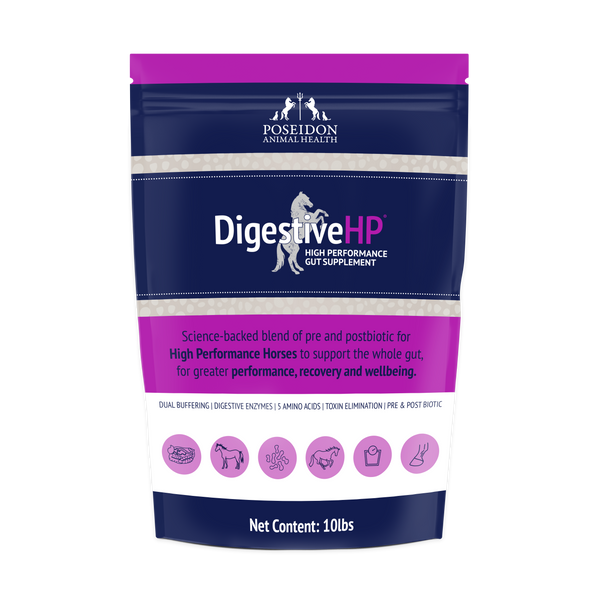
Built on published, equine-specific research.
Every ingredient in DigestiveHP is included at the dose studied in equine research — not extrapolated from other species. It's part of a complete feeding and management program, not a replacement for veterinary care.
Shop DigestiveHPFrequently asked questions
Do probiotics help horses with diarrhea?
The research does not demonstrate a consistent benefit of probiotics when administered to horses with diarrhea. One study of Saccharomyces boulardii suggested a decrease in duration of diarrhea; however, multiple larger, stronger studies indicated no beneficial effect of probiotics administered to adults with diarrhea compared to placebo.
Which probiotics are best for horses with ulcers?
There is no research in horses which demonstrates a beneficial effect of probiotics for horses with gastric ulcers.
Which probiotics are best for horses on antibiotics?
There is no research in horses demonstrating that probiotics should be administered to horses on antibiotics for the prevention of diarrhea.
Are probiotics safe for foals?
The available research repeatedly suggests that preventative probiotic administration is not safe for neonatal foals and may increase the risk of diarrhea severe enough to require veterinarian directed care.
Bottom line: probiotics, prebiotics, and postbiotics for horses
In conclusion, while some probiotics demonstrate the potential to alter microbial populations and inflammatory processes in horses, any clinical advantages are limited and product reliability is poor. Postbiotics, specifically Saccharomyces cerevisiae fermentation products, offer a promising alternative by using metabolite-driven mechanisms to help stabilize the microbiome, easing stress response, and supporting overall gastrointestinal health.
Talk to your veterinarian
As always, talk to your veterinarian before adding any new supplement to your horse's diet, especially for foals or horses with existing digestive issues.
References
- Schoster, A. Probiotic Use in Equine Gastrointestinal Disease. Vet Clin N Amer 2018;34(1):13.
- Weese JS, et al. Assessment of commercial probiotic bacterial contents and label accuracy. Can Vet J 2003;44:982.
- Berreta A, et al. Effect of an in vitro proximal gastrointestinal tract on viability of commercially available equine probiotics. J Equine Vet Sci 2021;104:103671.
- Berreta A, et al. Microbial variability of commercial equine probiotics. J Equine Vet Sci 2021;106:103728.
- Berreta A, et al. Equine probiotics — what are they, where are we, and where do we need to go? J Equine Vet Sci 2022;115:104037.
- MacNicol JL, et al. The influence of a probiotic/prebiotic supplement on microbial and metabolic parameters of equine cecal fluid or fecal slurry in vitro. J Anim Sci 2023;101:1.
- Cooke CG, et al. Effects of probiotics and prebiotics on the composition of equine fecal and seminal microbiomes and sperm quality: a pilot study. J Equine Vet Sci 2024;135:105032.
- Lagounova M, et al. The effect of dietary synbiotics in actively racing Standardbred horses receiving TMP/SFD. Animals 2023;13(14):2344.
- Jacobs RD, et al. Oral probiotic administration attenuates postexercise inflammation in horses. Transl Anim Sci 2024;13:8.
- Zhong Y, et al. Gut health benefit and application of postbiotics in animal production. J Anim Sci Biotechnol 2022;13:38.
- Valigura HC, et al. Dietary supplementation of Saccharomyces cerevisiae fermentation product attenuates exercise-induced stress markers in young horses. J Anim Sci 2021;99(8):1.
- Martinez R, et al. Response to an intra-articular lipopolysaccharide challenge following dietary supplementation of Saccharomyces cerevisiae fermentation product in young horses. J Equine Vet Sci 2017;76:80.
- Ganda E, et al. Saccharomyces cerevisiae fermentation product improves robustness of equine gut microbiome upon stress. Frontiers in Vet Sci 2023.
- Norton SA, et al. PSXV-17 Dietary postbiotic mediates cytokine gene expression in senior horses. J Anim Sci 2021;99(S3):360.
- Prasad S, et al. Postbiotics: Multifunctional microbial products transforming animal health and performance. Vet Sci 2025;12(12):1191.